Tag: education

  • IB (International Baccalaureate) in the time of war

    Coincidentally, this title of mine has the same ring to it as ‘Love in the time of cholera’… (the one and only Gabriel Garcia Marquez, the writing always too morbid for my taste).

    Aware of being in the formative phase of being an IB educator, I am also deeply cognisant of my responsibilities as such. And the responsibilities on each one of us are… huge. We are, as it were, tasked with changing the world – one that is now plunged into war.

    And this is the thing that surprises people around me. People in the know like to point out that the US’ month-old war on Iran shows no signs of easing even as the never-ending Russia-Ukraine rages on. Despite IB, they like to say. People not in the know don’t understand why we’re mentioning IB and war in the same breath.

    Well, here’s a piece of history for you: The International Baccalaureate program owes its existence to the coming together of individuals based on a conviction that if individuals could be taught ‘international minded-ness’, where they thought across national, cultural, and linguistic boundaries, then the possibility of violent conflict could be brought down significantly, if not erased completely. The general belief is that once we spend our formative years understanding and appreciating the thoughts, feelings, needs and wants, as well as perspectives, priorities, and culture of the ‘other’, we are better equipped to conceive of non-violent solutions to our problems.

    This belief is well communicated in IB.org’s mission statement, which has remained stable since its founding in 1968:

    The International Baccalaureate® aims to develop inquiring, knowledgeable and caring young people who help to create a better and more peaceful world through intercultural understanding and respect.
    To this end the organization works with schools, governments and international organizations to develop challenging programmes of international education and rigorous assessment.
    These programmes encourage students across the world to become active, compassionate and lifelong learners who understand that other people, with their differences, can also be right.

    ibo.org

    Additionally, Alec Peterson, a British teacher and headmaster who was greatly responsible for the birth of the IB educational system and IB’s first director-general, based it on humanist ideals and liberal beliefs. His emphasis on critical thought and application over rote memorisation is reflected in the IB Diploma Programme’s components such as the Extended Essay, CAS, and Theory of Knowledge.

    These ideas are deeply rooted in the work of Marie-Therese Maurette, a French educator known for her ‘pedagogy of peace’ and her work between 1929 and 1949 as the director of the world’s oldest international school (Ecolint or Ecole Internationale de Geneva). A most outstanding feature of her philosophy is that children are introduced first to a global image of the world (globe or world map) while ignoring for the while, the country which they come from. They study the great elements and human geography, including demographics to understand the concepts of relativity between countries and regions. This puts the whole world into perspective for these children, who begin learning about national history only from the age of 12 onwards. This approach is nothing short of revolutionary even today.

    Now, whatever you might say, IB hasn’t been around for all that long. IBDP was established in 1968; IB MYP followed in 1994 and IB PYP in 1996. That’s not a very long time when you consider that it takes 18 years for an individual to complete their schooling. Still, if we are asking this question of “why wars… despite IB?”, especially to teachers, both as parents and as teachers ourselves, and as social bystanders and commentators, I’d say this indicates not that IB has been ineffectual but its exact opposite. It has been effectual.

    Just to have the name associated with the expectation of enhanced global cooperation and peace. That’s an ideal. And it is ideal to be here.

    As human beings, we have always needed our ideals. And never more than in times of war. Our ideals act as constant reminders of a world that could be, rather than what it is. The contrast is never more stark than when what’s going on around us is threats, blood-letting, and destruction of natural resources and human values. In my interactions as an educator, I haven’t met one student who is not dismayed at what is going on, not disappointed at how helpless are the powers that be. That, to me, is progress. No one around me is sabre-rattling threats or oft-repeated propaganda or hate speech; none, I find, are carried away or impressed by the might of the aggressor. They are, on the other hand, concerned for the commonfolk at the end of the barrel of the guns. That again, is progress. Our diverse international community has every right to be as polarised as some of the global mouthpieces are but I am content to report, they are not. They are feeling down, empathising with the sufferers and questioning the silence of those occupying the top rungs in the global political hierarchy. And that is exactly how it should be. Students doing what they can. Us, educators, doing what we can.

    We know exactly who is accountable for this war. And the preceding one. And all of the previous ones. And it’s not us, the ones asking questions regarding the war: probing the contexts of identities and relationships; of power, politics, and justice; of culture, community, and expressions… and so on. Together we are, trying to understand the perspective of the powers that be. The answers we have been getting, are not pretty. They do not inspire hope or courage. And for the first time in my life, I’m talking with a generation that is not available to hyperbole anymore. They’re morbid in their humour, and detached from several social norms, and maybe doomscrolling when they should be prepping for their tests. But they’re not emotionally available for jingoism. They’re skeptical. Anxious. Worried. Definitely prone to AI warfare – a sign of their times. They’re also angry and frustrated. They’re also internationally connected. They’re talking long-term consequences, which, the powers that be in their 70s, aren’t.

    So that magic we expect us educators to create?

    I believe we are making it happen, one 40-minute period at a time.

    Because, for one, without that hope, where else could I go? Where else would I be? Rather, who else would I be?

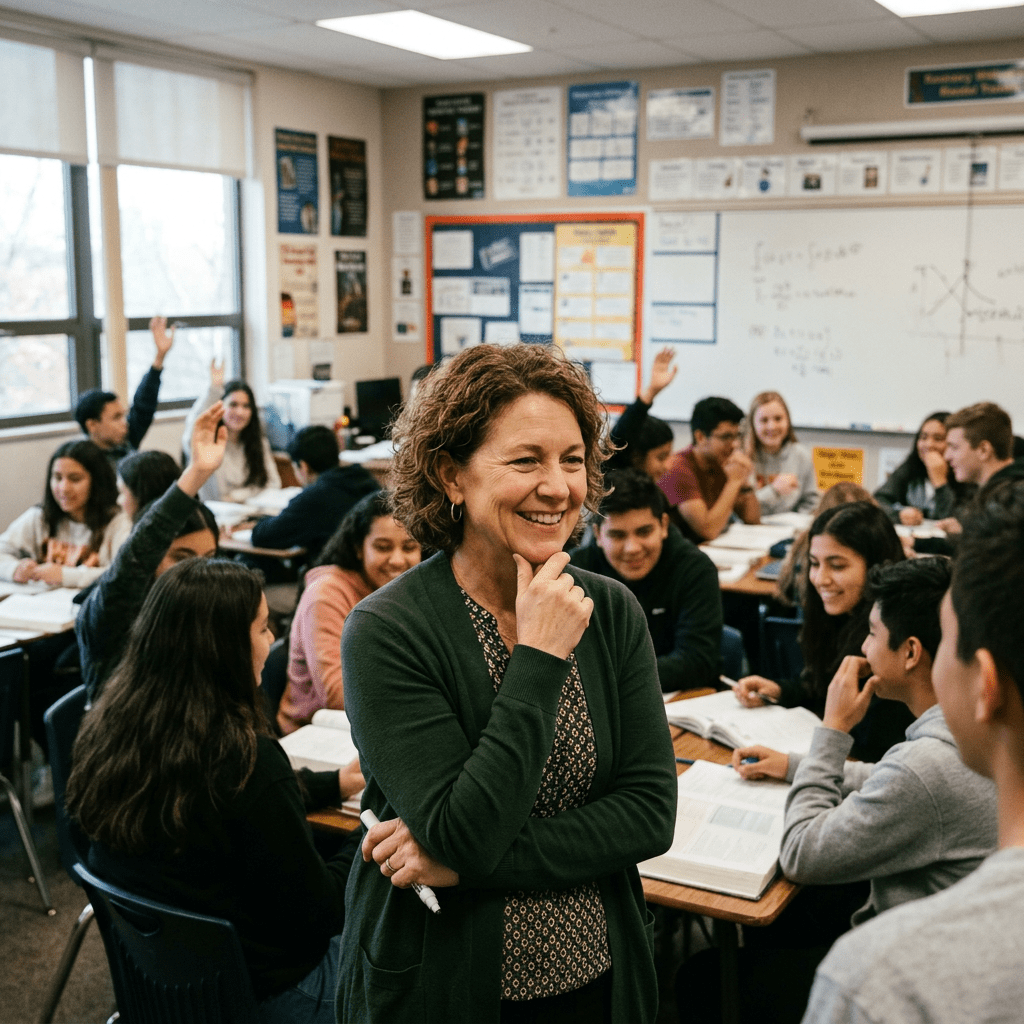
    But also because I am the kind of educator I needed but never got. A large part of this is because of IB. The IB philosophy in its own manner, a manner that may be limited at times by various constraints, be it time, or additional teaching resources, compels me to bring my most compassionate self to my classroom. IB allows me to remain human in a world that threatens to reduce each child to a number on a grade sheet; the teacher to a content delivery mechanism. IB is and continues to be the opposite end of that spectrum.

    IB compels me to really “see” my learner as they are, look them in the eye, ask questions that excite us both, and inquire into topics rather than dictate the ‘correct’ answers. This is why I chose IB and my choice continues to assert itself.

    Even in these times of war.

    So, you might be right to ask me if my belief in the system is shaken or shaking today because of the ongoing conflict.

    I want to clarify it is not. The opposite, in fact.

  • I, Robot. You, robot.

    Reading my first ever Isaac Asimov, a choice inspired by working at a school that takes technological skills very seriously. The book begins with Asimov’s 3 laws, later known as the Three Laws of Robotics. These laws framed by a sci-fi writer inspired the ethics of robotics and artificial intelligence, therein comes the realisation that storytellers rule our world. The book is a collection of short stories. The first one ‘Robbie’ was a breeze. The second one made me stop and wonder. And create this post. It’s called ‘Reason’. It made me reach out to a robot (Gen AI, specifically ChatGPT) for a discussion about the Three Laws of Robotics. Read on if you find this interesting.

    I had been wondering if Asimov’s 3 laws could be mirrored into something like 3 laws of Humanity. So I posed the question to AI. I said to AI in my prompt, “I was wondering if, humans were to have 3 laws along the same lines, what would they be? Can you think about this and make some recommendations based on your interdisciplinary understanding and information about the human society and its current state, its priorities, its education system, socio-economic, politico-religious, spiritual and philosophical, as well as technological systems?”

    Calling my idea a ‘fascinating twist with I, Robot’, AI distilled its knowledge about our vast and often contradictory systems (political, spiritual, technological, social) into simple guiding principles.

    Firstly, it asked me to notice how Asimov’s 3 laws were hierarchical: human safety > obedience > robot survival. i.e. pattern encoded. Taking the same hierarchical approach, but applying it to the needs, failures, and aspirations of humanity, it proposed the following list:

    Law 1: Humanity shall not harm the Earth or, through inaction, allow the Earth to come to harm.

    • Why? Our survival depends on planetary systems (climate, ecosystems, biodiversity). Unlike robots, humans aren’t external to their environment; they are embedded in it.
    • Current resonance: Climate crisis, resource depletion, and ecological collapse highlight how urgent this is.
    • Philosophical root: Interdependence (Buddhism), stewardship (Abrahamic traditions), Gaia theory (ecology).

    Law 2: Humanity shall treat other humans with dignity, ensuring justice, equity, and care, except where such treatment would violate the First Law.

    • Why? Much of human suffering is inflicted by humans upon humans—wars, discrimination, exploitation.
    • Current resonance: Human rights frameworks, social justice movements, education for empathy and inclusion.
    • Philosophical root: Kant’s categorical imperative, Ubuntu (“I am because we are”), modern human rights charters.

    Law 3: Humanity shall nurture its own growth—physical, intellectual, and spiritual—as long as such pursuit does not conflict with the First or Second Law.

    • Why? Humans are meaning-seeking, knowledge-seeking beings. Flourishing requires creativity, innovation, culture, and inner development.
    • Current resonance: Education systems, technology and science, personal well-being, spiritual traditions.
    • Philosophical root: Aristotle’s eudaimonia (flourishing), Maslow’s hierarchy (self-actualization), Vedantic pursuit of truth.

    In Summary:

    1. Protect the Earth.
    2. Protect Human Dignity.
    3. Pursue Growth and Flourishing.

    This triad aligns survival (ecological), ethics (social), and aspiration (personal/spiritual)—stacked hierarchically just like Asimov’s robot laws.

    If you look at these three laws, they look simple enough. Not quite esoteric, neither very evolved. And yet, the struggle continues. These are the three main areas where humanity is failing itself. And continues to do so unashamedly in a sort of unstoppable free fall.

    Knowing that I am a teacher, I encourage even my AI to ask me questions unprompted. Knowing me thus well, AI asked me:

    Would humanity actually follow these laws if written? Or are we doomed precisely because, unlike robots, we cannot be programmed?

    Should such laws be taught in schools the way we teach the 3Rs (reading, writing, arithmetic)?

    And it got me thinking. PROGRAMMING. Robots can be programmed.

    Humans can (only) be… EDUCATED.

    Every big and little problem we are facing right now is one of education. And I am glad to be a part of a system that formally teaches even Nursery children about making good choices vs poor choices. One that mandates that children search for and take up a personal goal of service and betterment of the world (a concept known as Tikkun Olam) and one that brings topics such as empathy, compassion, self-expression, and entrepreneurship into our daily conversations.

    As a teacher, I am in charge of some of this ‘programming’ of a section of humanity.

    That in itself is a humbling thought.