• Purpose and goals: Know which rabbit you want to catch

    Part-2: Lessons from Jack Ma’s success and Vadilal’s not-so-successful ice-cream run

    Prakash Iyer, in his book ‘The Habit of Winning’ uses Jack Ma’s Alibaba.com and Vadilal’s ice-cream business to talk about the power of focus. He reports on an event he attended in 2000, where he witnessed Jack Ma, in flesh and blood, talk about how alibaba’s success was built on ‘not changing the rabbit’. At this event, Jack Ma said that if there are nine rabbits running around and you want to catch one, focus only on one. “If you try to catch them all, you may end up with none. If the rabbit you’re chasing proves elusive, change your tactics. Don’t change the rabbit.”

    ‘Powerful advice that’, says Iyer. I would agree. If you’re certain you only want to catch one rabbit, you’re right to focus on just one. Learn its specific behaviour and tailor your tactics accordingly, he explains. Makes perfect sense. In retrospect all success does. In retrospect, all failure does too. He juxtaposes the story of Gujarat’s Vadilal ice-cream with that of Alibaba. According to Iyer, Vadilal chased more than one rabbit – ready-to-eat foods, ice-cream, forex, real estate, chemicals… and, so it’s not where Alibaba is. But, and I checked, Vadilal is still going strong as a brand, expanding its business (reported EBITDA of 186.88 Cr in 2025, up from 165.69 Cr a year before).

    The thing that most people do, especially management folks, is try to rationalise success (and failures), blindly following Harvard’s case study method. In my opinion, it is no better than Indian parents telling their wards about the neighbour’s class topper son, “Look, Amit did it, why can’t you?”

    They don’t consider the multitude of things that led to that one specific success or failure. When Jack Ma had the idea to start Alibaba, he had had to have been an English teacher in Beijing. He had had to have had proficiency in English that made him a person in great demand when English-speaking businessmen flew in as delegates from other countries, trying to do business in China. He had had to have such contacts, as well as credibility, as to find him at the core of those meetings. He had had to have had the entrepreneurial chops to conceive of alibaba along with at least 18(!) friends who’d pledge their money into his startup. Jack Ma also had had to have the kind of ecosystem accessible to him through China’s pro-business policies that made alibaba grow and survive a big bust later on.

    The same can be said of Bill Gates, Steve Jobs, and everyone else who succeeded and who didn’t. Market factors, the environment at home, personality, individual goals, ecosystem, everything counts. Change one factor and everything changes. The case study method, while effective in helping students understand a concept by example, is truly narrow when trying to communicate nuances. It focuses on one or two aspects of successes while others go unexamined.

    To use Amit’s analogy…

    Chances are that Amit’s parents filled up their home with books, maintained strict boundaries and had high expectations of their son, while Amit, himself, was born with a disposition that makes him interested in academic enquiry. He’ll probably crack the top engineering exams or become a doctor. Or a scientist at a big uni abroad. But, it could have swung the other way as well. That Amit’s dad was a hard taskmaster, sometimes meting out corporal punishment, while his mother, scared of conflict, choose to look the other way, and Amit performed well simply out of fear of being punished. Amit may be a board topper now; but he might have his first nervous breakdown at 32. Who knows what will happen. Really.

    But you’re not Amit, are you? Your parents are not his parents. And so, if he is chasing a rabbit, you’re perhaps chasing an elephant, or a penguin, or a bat. Again, who knows? Therefore, you need to find out what you want to chase. And be ready to pay the costs. We merely assume that Alibaba got its rabbit – domination in China/world(?). We don’t really know at what cost. Its income bar charts show an up-trend but do we know what really goes on behind the business and in the lives of those people involved? The Chinese have a culture of 9-9-6, do we want that? It’s too simplistic to think that individual successes (and failures) are so fungible. We know for sure that Jack Ma was not seen in public for a long time, causing intense speculation. That’s the issue with the case study method. It gets worse when this method becomes normalised, as self-help genre has done.

    When the future has happened, it’s easy to look back and say, “Oh, now I know why this happened”. Or, as Steve Jobs once said, “You can’t connect the dots looking forward; you can only connect them looking backwards. So you have to trust that the dots will somehow connect in your future.”

    Vadilal and Alibaba both trust that dots will connect somehow in the future. Neither is a story finished. If one is chasing a rabbit the other is chasing… not a rabbit. Both are okay. Guys like Iyer try to say that success is linear. That’s it’s only the shape of a rabbit. No. Success is many different things in different contexts. It’s a shape-shifter. It’s the most adaptable animal there is, actually.

    Speaking of personal experience, success to me was once leading the content strategy for a company and getting them noticed across various media platforms. Then it was doing 40+ projects a year for various clients at a stakeholder communications firm. Now as a single mom, success is to be able to find the time to play a game of carrom and make art with my son each day while balancing my responsibilities as a full-time educator teaching in a school. I’m an English teacher too, like Jack Ma, but I don’t want to set up an alibaba even if my 18 friends pushed me into it. I don’t want to go down that rabbit-hole.

    Management speak is all about homogenising this definition of success. That approach doesn’t work – it robs us of our humanity. Unfortunately, most management leaders have all the power but very little wisdom to realise this.
  • What trips us up on our way through life: Purpose-less goals

    Part 1: In other words, management leaders love to talk about goal-setting but they ignore crucial steps that must come before

    There’s a whole science dedicated to goal-setting – there are goals and there are SMART (Specific, Measurable, Achievable, Realistic, Time-bound) goals. Someone the pointed out that your definition of ‘achievable’ may just be what’s keeping your goals too limited and so they gave it a C for challenge. Now, goals are supposed to be SMART-C where your definition of what you can achieve is constantly being challenged by the added C. These are important conversations to have but surely we’re missing something when we lose the sight of our goals from time to time.

    SMART-C in December, gone by Feb… that doesn’t sound like effective goal-setting in the first place. I’ve been there myself and from my experience, I can say there’s nothing wrong with the idea of setting goals in the first place. The SMART and SMART-C iterations are fine as well. But, when the entire operation goes belly up by February, the defenders of goal-setting try to pin the blame on your sense of commitment at some point. Then your sense of discipline gets called in. It becomes collateral damage. Your self-esteem pays the price. Come December, here’s an opportunity for a do-over. The business is cyclical. It keeps these professionals in business.

    Therefore, it helps to be reminded of the needed to set goals from time to time, as I was just now while reading Prakash Iyer’s ‘The Habit of Winning’, which happens to be my Secret Santa gift by the way. He puts it simply:

    ‘It takes just three steps.

    Step one: Write down your goals.

    Step two: Make a commitment to action, to doing what it takes.

    Step three: Take the first step. Today!’

    That’s it. And that’s all. Easy-peasy apple squeezy, like my kindergarten-going kiddo says. If you remind him it’s lemon-squeezy and not apple-squeezy, he says he’d like to squeeze apples instead. Then you stop and think, yeah, let’s squeeze apples as easily as we squeeze lemons. wow. There’s something there. But we’re distracting ourselves.

    Prakash’s reminder to set goals is very welcome. But, its portrayed simplicity misrepresents the level of complexity involved. Most humans are like robots conditioned by their basic impulses and their upbringing. And if they weren’t exposed to the magic of delaying gratification, productive work, etc. their operant conditioning drives their entire life. Because if their operant conditioning allowed them, they’d be in Prakash Iyer’s place writing this book and teaching others about goal-setting.

    Our yearnings indicate what we lack. And if we lack the clarity to set goals, asking people to set goals is not the step One. Iyer’s step one is far upstream of step 0, which is to look for clarity. That should be your goal 1. Clarity – what do you want to do and why. And what you do NOT want to do and why. Often times, it’s easier to define what you do NOT want to do, which then leads you to what you do want to do. That Clarity bestows a certain direction for you, which illuminates your purpose. Once this is done, you can define your goals, set them, adopt them, design them, and all that jazz. Easy-peasy.

    My realisation is that as people, we lack this clarity. We don’t know what we really want to do with ourselves. And most of this is the outcome of such operant conditioning. Which, again, leads you to a life where you keep hunting for goals while actually you should be looking for clarity. For one who is clear, goals become a scale. For one who isn’t, goals are obstacles that they try to pile higher and higher while failing through it all, looking back at the finishing line with regret. Sometimes even remorse.

    I’ve seen that it’s usually the management guys that love to talk about goals and goal-setting. I think it’s intuitive for them because they assume that purpose and clarity are theirs to champion. That they’re the custodians of the purpose and clarity of the people they manage. And so, the only thing that remains for you to do is define and set your goals and spend your life trying to achieve them.

    Almost like: “When I ask you to jump, you say “how high?”” Classic management speak. This is what creates the classic burnout and the quiet quitting and all its varieties.

    But now, times are a changing. We’re less and less in thrall of managers. The big sharks are talking agency. They want us all to exercise their agency. We’re coming out of those discussions feeling like Rip van Winkle just woke up in a new world.

    More about this in my next post.

  • Instead of telling our kids stories, let’s teach them how to tell stories

    The story of Pepsi and Coca-Cola fought the Cola wars continue to inspire many a case study at Indian business schools for everything around market capture, customer research, genius of ad campaigns, and what not.

    Prakash Iyer in his book ‘The Habit of Winning’ highlights a former Pepsi CEO’s smart use of storytelling to inspire others to action. It’s a modern retake of the old “I’m not breaking stones, I’m helping to build the world’s tallest cathedral”.

    So this former CEO recognised that to win the cola war, they needed an infantry at the front lines: sales. Feet on the street. You tell a salesperson to work on commissions, performance-linked incentives, etc. you get only so much (itne paise mein itna hi milega). You flip the org chart upside-down and tell her she’s the one on top while you, the CEO, are at the very bottom. Suddenly, your infantry believes they have superpowers.

    Iyer writes this CEO literally did just that. Flip the org chart – making that his favourite slide ‘in any presentation’. The brand went an extra mile by making an ad featuring a Pepsi salesman scolding Sachin Tendulkar for smashing a ball into the windshield of his Pepsi truck, later asking him to chill and have a Pepsi.

    Feels great. The power of good storytelling is supreme.

    Iyer explains that it isn’t surprising that Suman succeeded in creating a first-rate sales team, where every salesman and every route agent who drove a Pepsi truck saw himself as a hero, out on a battle.

    No, it isn’t surprising at all.

    This is exactly why we should stop telling stories in school and teach storytelling instead. There’s a big difference to it. Storytelling is a different skillset.

    When a mind is conditioned to listen to stories, we’ll believe any story that appeals to our emotions. Think Santa. Think ‘Slow and Steady wins the race’ and ‘Friend in need is a friend indeed’. From there on, you’re a hop, skip, and jump away to ‘you’re helping Pepsi to win the cola war. Not just ‘selling Pepsi’‘, by the time you’re in a business school.

    When you learn about storytelling, you learn how to hook your listener, how to create emotional blips designed to make them feel for the characters. You know that when this happens, thinking stops. They buy into your version. You. Your product or proposition.

    Something else happens when you learn how to tell stories: you learn to spot the storyteller. The one who tells you what to hear, where to focus, and what to do. It could be your boss, your political leader, your spiritual guide, even you. Your own self.

    When you learn how to tell stories, you learn how to mix facts with fiction, action with emotion. You learn to discern.

    We should make way for the rhetorical triangle (ethos-pathos-logos, the very same) to be seen and taught by schoolkids so that when a CEO flips the org chart downwards on that new trainee, the latter can ask if the pay ratio CEO-to-worker also reflects a similar nuance.

  • I, Robot. You, robot.

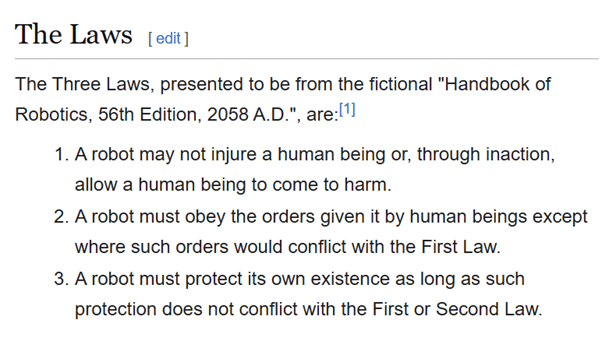
    Reading my first ever Isaac Asimov, a choice inspired by working at a school that takes technological skills very seriously. The book begins with Asimov’s 3 laws, later known as the Three Laws of Robotics. These laws framed by a sci-fi writer inspired the ethics of robotics and artificial intelligence, therein comes the realisation that storytellers rule our world. The book is a collection of short stories. The first one ‘Robbie’ was a breeze. The second one made me stop and wonder. And create this post. It’s called ‘Reason’. It made me reach out to a robot (Gen AI, specifically ChatGPT) for a discussion about the Three Laws of Robotics. Read on if you find this interesting.

    I had been wondering if Asimov’s 3 laws could be mirrored into something like 3 laws of Humanity. So I posed the question to AI. I said to AI in my prompt, “I was wondering if, humans were to have 3 laws along the same lines, what would they be? Can you think about this and make some recommendations based on your interdisciplinary understanding and information about the human society and its current state, its priorities, its education system, socio-economic, politico-religious, spiritual and philosophical, as well as technological systems?”

    Calling my idea a ‘fascinating twist with I, Robot’, AI distilled its knowledge about our vast and often contradictory systems (political, spiritual, technological, social) into simple guiding principles.

    Firstly, it asked me to notice how Asimov’s 3 laws were hierarchical: human safety > obedience > robot survival. i.e. pattern encoded. Taking the same hierarchical approach, but applying it to the needs, failures, and aspirations of humanity, it proposed the following list:

    Law 1: Humanity shall not harm the Earth or, through inaction, allow the Earth to come to harm.

    • Why? Our survival depends on planetary systems (climate, ecosystems, biodiversity). Unlike robots, humans aren’t external to their environment; they are embedded in it.
    • Current resonance: Climate crisis, resource depletion, and ecological collapse highlight how urgent this is.
    • Philosophical root: Interdependence (Buddhism), stewardship (Abrahamic traditions), Gaia theory (ecology).

    Law 2: Humanity shall treat other humans with dignity, ensuring justice, equity, and care, except where such treatment would violate the First Law.

    • Why? Much of human suffering is inflicted by humans upon humans—wars, discrimination, exploitation.
    • Current resonance: Human rights frameworks, social justice movements, education for empathy and inclusion.
    • Philosophical root: Kant’s categorical imperative, Ubuntu (“I am because we are”), modern human rights charters.

    Law 3: Humanity shall nurture its own growth—physical, intellectual, and spiritual—as long as such pursuit does not conflict with the First or Second Law.

    • Why? Humans are meaning-seeking, knowledge-seeking beings. Flourishing requires creativity, innovation, culture, and inner development.
    • Current resonance: Education systems, technology and science, personal well-being, spiritual traditions.
    • Philosophical root: Aristotle’s eudaimonia (flourishing), Maslow’s hierarchy (self-actualization), Vedantic pursuit of truth.

    In Summary:

    1. Protect the Earth.
    2. Protect Human Dignity.
    3. Pursue Growth and Flourishing.

    This triad aligns survival (ecological), ethics (social), and aspiration (personal/spiritual)—stacked hierarchically just like Asimov’s robot laws.

    If you look at these three laws, they look simple enough. Not quite esoteric, neither very evolved. And yet, the struggle continues. These are the three main areas where humanity is failing itself. And continues to do so unashamedly in a sort of unstoppable free fall.

    Knowing that I am a teacher, I encourage even my AI to ask me questions unprompted. Knowing me thus well, AI asked me:

    Would humanity actually follow these laws if written? Or are we doomed precisely because, unlike robots, we cannot be programmed?

    Should such laws be taught in schools the way we teach the 3Rs (reading, writing, arithmetic)?

    And it got me thinking. PROGRAMMING. Robots can be programmed.

    Humans can (only) be… EDUCATED.

    Every big and little problem we are facing right now is one of education. And I am glad to be a part of a system that formally teaches even Nursery children about making good choices vs poor choices. One that mandates that children search for and take up a personal goal of service and betterment of the world (a concept known as Tikkun Olam) and one that brings topics such as empathy, compassion, self-expression, and entrepreneurship into our daily conversations.

    As a teacher, I am in charge of some of this ‘programming’ of a section of humanity.

    That in itself is a humbling thought.

  • Understanding advertising

    As a school student, you may wonder about the place for advertising in your English class.

    Why do we need to study advertising at all and what has it got to do with the study of language? Advertising is among the most common (I want to use the word pervasive – if only there was a way to soften its negative connotation somewhat) forms of communication in our lives. The pervasiveness of advertising seems to be a direct consequence of its effectiveness as a form of persuasion. An average person today receives anywhere between 200 and 4,000 advertising messages in a day. According to business reports, the advertising industry is worth more than 1 Trillion US Dollars and is expected to continue to grow its economic and persuasive power.

    Advertising is persuasion in action. We give in to it day in and day out. Advertisements tell us what to buy (eat, wear, invest), where to go and what to do. And we listen. Thus, understanding advertising as a topic helps us identify and critically analyse the daily persuasions we face, thus making us more aware as a consumer. In today’s day and age, it has become an essential aspect of media literacy. By learning to critically analyse advertisements, we appreciate the diverse ways in which advertising contributes to economic growth. It also illuminates the principles of persuasive communication, which are key to acquiring communication skills necessary for thriving in the 21st century.

    Growth of advertising as a discipline is testament to its effectiveness in communicating messages in a manner that audiences find relevant, creative, and engaging. Advertisements are deliberately designed to engage viewers by evoking emotions. These emotions cause people to react in favour of the product, service, or ideas being propagated. For example, I may be interested in watching an advertisement of a sports car simply because I enjoy watching it, with no intention of actually buying the said car. Because I like watching the advertisement, I may not change the channel on the TV or skip the advertisement on the digital platform if this advertisement shows. Here, I am a consumer of the advertisement’s message rather than the car itself. This is how certain products and brands become household names, well-known and well recognised.

    This pervasiveness of advertisements also means that whether or not we consume the products or services or ideas from these advertisers, we end up consuming these advertising messages a lot more. This is also how advertisements and brands become part of the popular culture and take the form of memes, even. Clearly, a consumer is a generic term. It includes people who may or may not buy your product, services, or ideas and people who consume advertising messages for these products, services, or ideas. The target consumer, is someone with the ability and the need to buy these products or services, or buy into these ideas. It is also clear that the target consumer group for any business at any instant will be a small subset of its (overall or larger) consumer group. In order to target this very specific consumer group, the business will use marketing and advertising (M&A) techniques for persuasion.

    In this segment, we focus on advertising specifically. Advertising is a function that supports the marketing efforts of a business. It is distinct from marketing in the following ways:

    The advertiser must put in efforts to isolate its target consumer within the consumer group either by:

    a) sharpening their ability to target this consumer or

    b) by deploying strategies to move as many consumers as possible into the target consumer group.

    These efforts fall under the marketing and advertising strategy of a business and are extremely important for sales promotion. Sales and marketing (advertising included) go hand in hand, particularly in the modern world where a multitude of products vie for the consumer’s attention.